Time is something more than a measure of our observable universe. For example, the Earth rotates counterclockwise on its axis every 24 hours, so we measure a day by this consistency. The Earth also rotates around the sun every 365 days, so we measure a year based on this constancy. However, why have we divided a day into 24 measurable units of 60 minutes, each 60 seconds long? Where did 24 and 60 come from? The time for these smaller measurements is a convention. Something defined by humans and not necessarily the result of an astronomical observation. To make matters worse, Earth's movements don't last exactly 24 hours and 365 days, but that also depends on how you look at them. We'll keep things simple as this won't be a lesson in astrophysics, but there is an interesting history of humanity about how time was defined.
60 seconds in a minute…? Meet the Sumerians and Babylonians
Let's go back to around 3500 BC. BC, when the Sumerians (from southern Mesopotamia) created a sexagesimal number system based on the number 60. It is believed that 60 was used because it has many divisors (divisible by 1, 2, 3, 4, 5, 6, 10, 12, 15, 20, and 30), allowing multiple and precise options for dividing a day with comparable practicality for astronomical and mathematical calculations. A “universal” number, if you will. The ancient Sumerians lived in Sumer (modern-day Iraq) and were among the first to have complex cities with agriculture, writing (known as cuneiform), and inventions such as the wheel. However, this sexagesimal system was not developed until around 2000 BC. refined by the Babylonians into something more familiar by today's standards.

The Babylonians succeeded the Sumerians (rather than conquering them), followed the rule of the Akkadians, and inherited much of the Sumerian culture and knowledge. The sexagesimal system was further developed to create the 60-minute hour and the 60-second minute. The sun appeared in the same place in the midday sky every 24 hours, so we had the 24-hour day made up of 60-minute hours. Technically, compared to fixed celestial objects like stars, the Earth rotates every 23 hours and 56 minutes (a sidereal day), but it compensates for this a bit because it also rotates around the sun, so the sun reappears in the same midday sky every 24 hours (a solar day). From a practical point of view, the solar day makes sense for timekeeping and calendars. This sophisticated Babylonian base 60 system has stood the test of time for thousands of years and is the reason your watch face is divided into 60 seconds and 60 minutes. Since 60 has so many dividers, we also have detailed 15-minute scales on dive watches, 30-minute counters on chronographs, and so on.
Why 24 hours a day? The rules of ancient Egypt
Although the base 60 system was used as early as 1500 B.C.E. When it was established in the 1st century BC, the Egyptians further developed time measurement with highly developed sundials. A T-shaped sundial was used to divide sunrise and sunset into 12 equal parts, i.e. 12-hour days and 12-hour nights. By using the duodecimal system in addition to the earlier sexagesimal system, time was further refined. A combination of 18 stars was observed at night, accurately dividing the remaining 12 hours of Earth's rotation. All of the above civilizations have developed mathematical methods for measuring celestial consistencies using the number 60 and its divisors – the rotation of the Earth on its axis and its orbit around the Sun, as well as the identification of specific night stars.
Now let's go back to around 3000 BC. 400 BC, when the Egyptians developed a solar calendar based on a 365-day year divided into 12 months. It was not the first calendar based on solar events, as this dates back to the Yoruba calendar around 8000 BC. BC can be traced back (although even older stone arrangements are being examined). The calendar had three seasons of 120 days each and an intercalary month of 5 or 6 days (the latter was a type of leap year) to balance the year. Each month was measured into three 10-day periods called deans, with the last two days of each dean being a non-working weekend for royal workers. Not until 45 B.C. In 200 BC, the Romans under Julius Caesar refined the Egyptian template with the Julian calendar, which added a more familiar leap year to accommodate minor differences between time measurements and actual solar time (e.g. the regular setting of a clock that inevitably runs somewhat fast or slow). Even with a leap year, the Julian calendar was not perfect and became increasingly inaccurate over the centuries – about one day off per century.
Curiosities in the calendar – solar calendar vs. lunar calendar
The modern and most widely used solar calendar today is the Gregorian calendar, a refined version of the Julian calendar created in 1582 by Pope Gregory XIII. was introduced. Leap years have been adjusted so that an average year is 365.2425 days, compared to 365.25 days in the Julian calendar. The difference sounds subtle, but it is more accurate over centuries because Earth's actual solar year is 365.2422 days. The Gregorian calendar is divided into 12 months of 30 or 31 days, with February having 28 or 29 days (with the leap year every four years). The extra day in a leap year is used to keep the calendar in sync with the true solar year. When it comes to different centuries (past and future), there are additional rules for leap years, but let's not overcomplicate it.
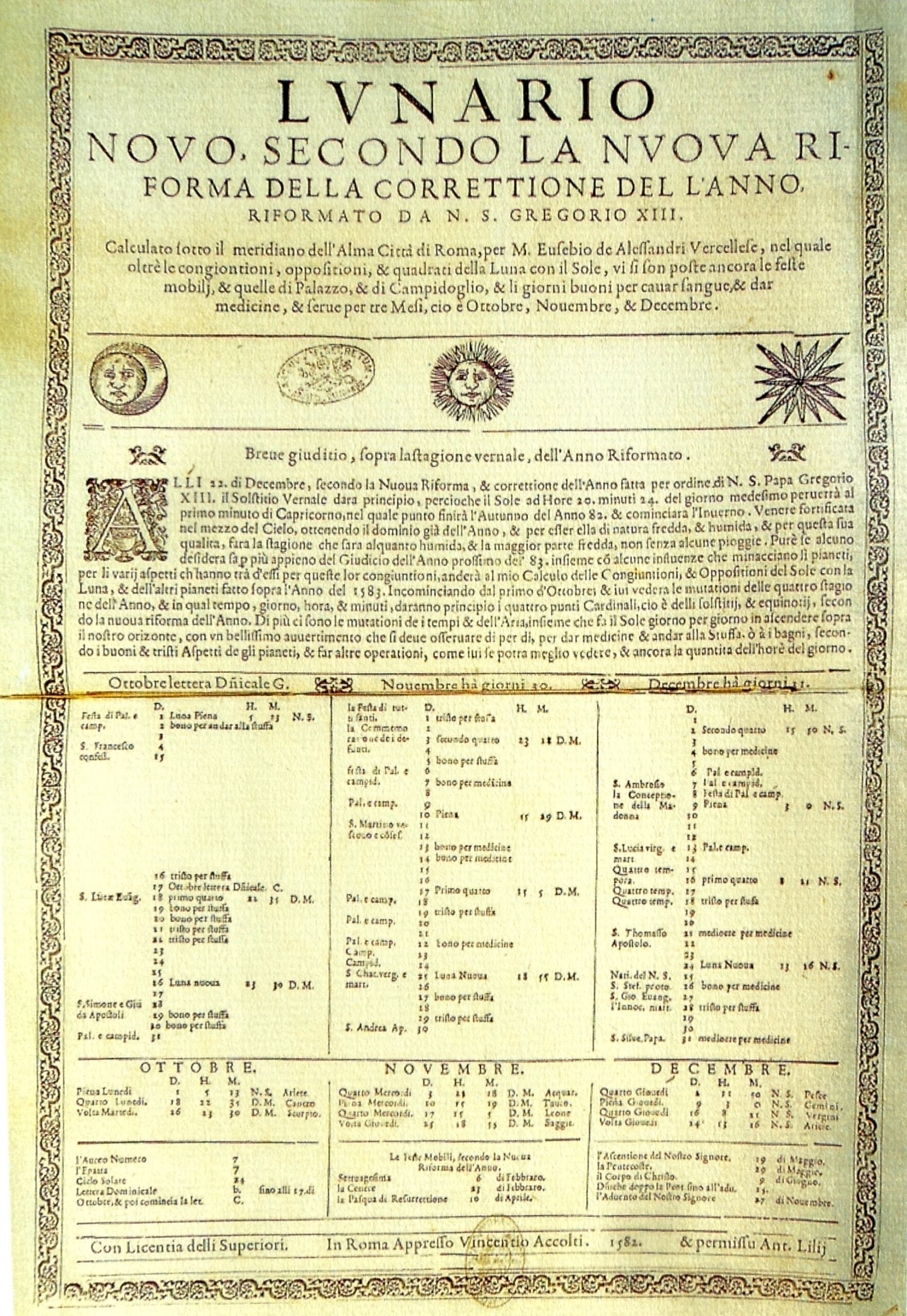 Lunario Novo, After the New Reform of the Annual Correction of NS Gregory XIII, printed in Rome by Vincenzo Accolti in 1582, one of the first printed editions of the new calendar – Source: Wikipedia
A lunar calendar tracks the monthly phases of the moon, called synodic months. Therefore, a lunar year is about 11 days shorter than a solar year, as the average time between new moons is 29.5 days. 12 lunar months are approximately 354 days compared to a solar year of 365 days. Lunisolar calendars combine both by regularly adding an intercalary month to stay in sync with the solar calendar and the four seasons. Lunar calendars are primarily known in China, but are also found in Islamic, Hebrew and Hindu cultures. They are used for religious and traditional events and also to track the world's tides, as the moon has a major influence on our oceans.
Lunar calendars are older than solar calendars, as ancient civilizations from the Upper Paleolithic (32,000 BC) are known to have tracked lunar phases using cave drawings. However, it was the Sumerians again around 3100 BC. The first “modern” lunar calendar was developed in the 1st century BC, sporadically adding a 13th month to keep pace with the solar year.
Let's apply all of this to a wristwatch
A perpetual calendar watch is the perfect proof of the story mentioned above. Let's take a look at the Frederique Constant Classic Perpetual Calendar Manufacture, which is one of the most affordable mechanical perpetual calendar manufacture watches on the market. When we look at the dial, thanks to the Sumerians, we see the hour hand based on 60 minutes and the minute hand based on 60 seconds. The hour hand makes two revolutions per day with a 12-hour day and a 12-hour night format, generally thanks to the ancient Egyptian sundials and the duodecimal system. The calendar is based on the modern Gregorian type (thanks to Pope Gregory The subdial at 3 o'clock shows the days of the month (up to 31) and adjusts properly between 30 and 31 days as well as the 28 or 29 days of February. The subdial at 9 o'clock shows the days of the week. A moon phase complication can be seen at 6 o'clock, which not only accurately shows the phases of the moon throughout the month, but also acts as a type of lunar calendar and can be used to track the 354 days of a lunar year.

It is interesting to see how timekeeping and its application to calendars was invented thousands of years ago. Of course, our observable universe is timeless and has a consistency that allows for this precise measurement with occasional adjustments, refined over centuries and millennia.
https://monochrome-watches.com/why-60-seconds-in-a-minute-why-60-minutes-in-an-hour-by-24-hours-in-a-day-and-other-calendar-oddities/