Not many contemporary watchmaking creations have influenced our perception of timekeeping as dramatically as the 2001 Ulysse Nardin Freak and Urwerk's wandering hour satellites. Both emerged from the creative boom of the late 1990s, when mechanical watchmaking clearly demonstrated its experimental and innovative spirit. Ulysse Nardin's “Freak” redefined the mechanical wristwatch by eliminating the dial, hands and crown, turning the entire movement into a timekeeping carousel and pioneering the use of silicon in watchmaking. Urwerk, founded in 1997 by Felix Baumgartner and Martin Frei, has reinvented the display of time itself with its orbiting satellite hours.
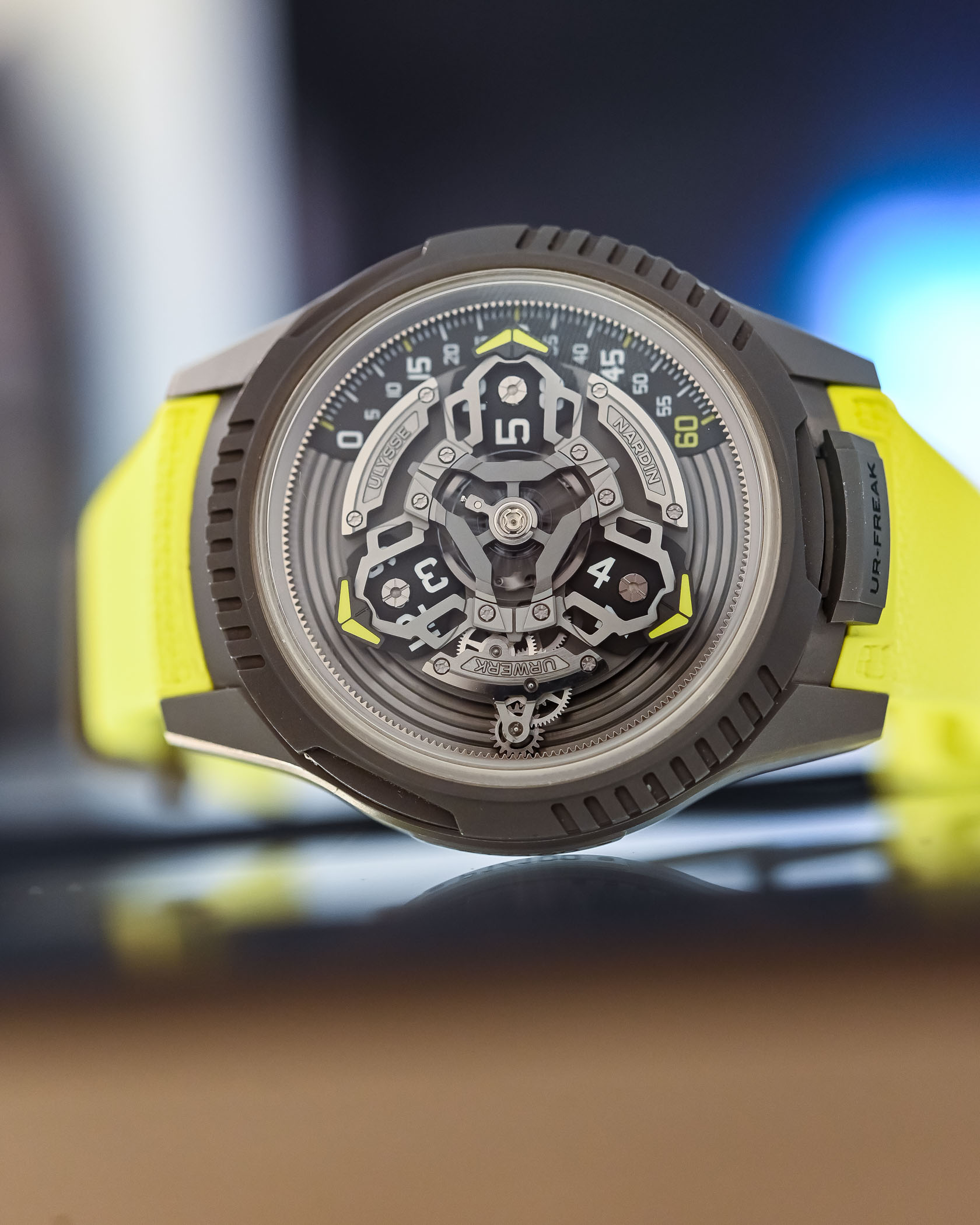
Now, in 2025, these two paths converge… And surprisingly, everything feels natural and familiar… The UR-FREAK is the first collaboration between Ulysse Nardin and Urwerk, a three-year project that combines the Freak's kinetic architecture with the Freak ONE's UN-240 caliber used as a base, along with Urwerk's signature orbital hour satellites, integrated into a single, fully integrated movement. It is not a co-signed cosmetic crossover, but a technical synthesis, a new mechanism born from shared philosophies: independence, creative courage and uncompromising. Enough of the praise, let's discover the extraordinary timepiece UR-FREAK.
The case work
Housed in a 44mm sandblasted titanium case, the UR-FREAK combines the design codes of Ulysse Nardin and Urwerk in a single, cohesive form. Its rounded silhouette is a copy of the Freak ONE, and the fluted titanium bezel and exposed mechanical layers are reminiscent of Urwerk's angular geometry and kinetic architecture. Despite the complex movement inside, the case has a low perceived height of 12 mm thanks to an integrated construction and a compact automatic winding system.
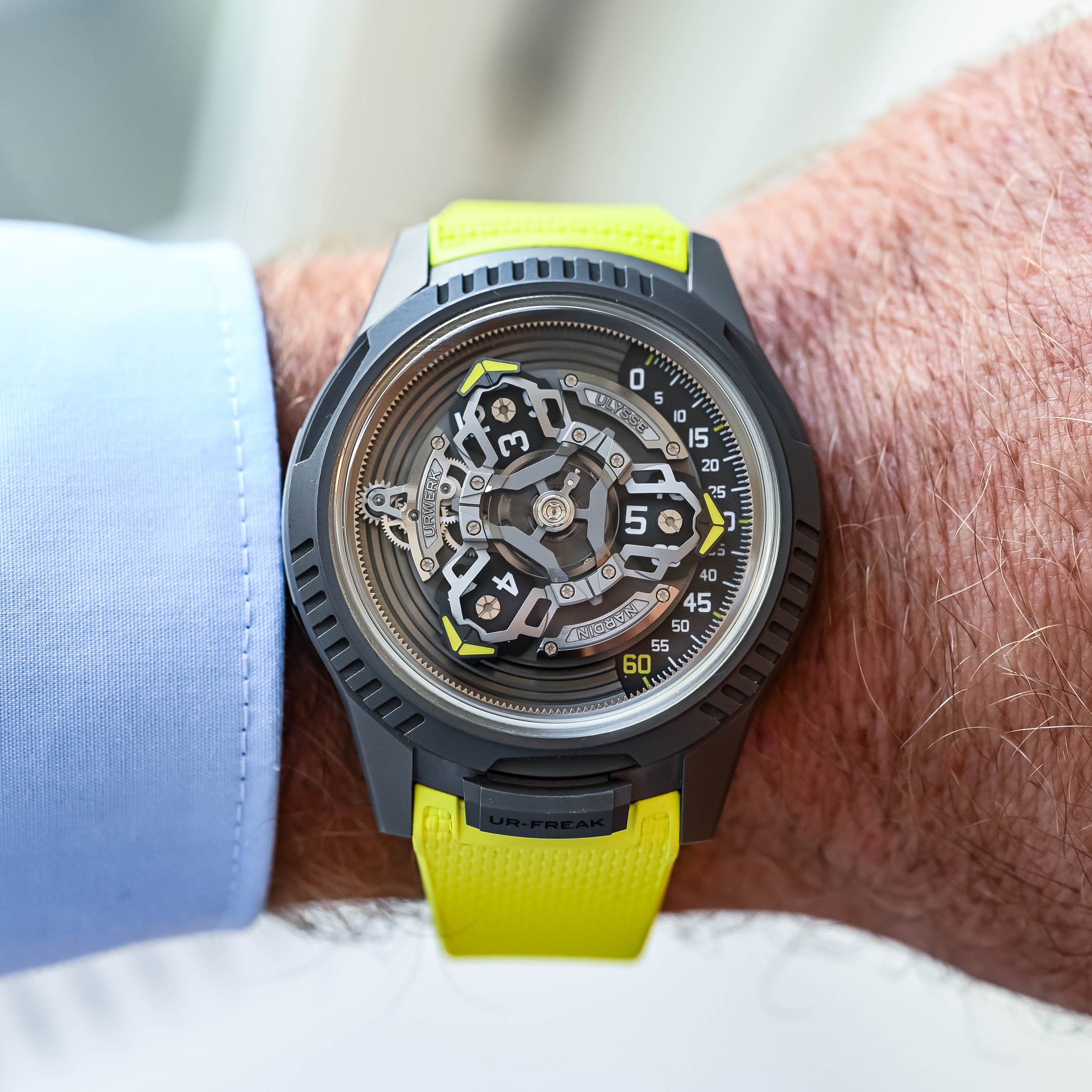
According to the Freak's founding principle, the UR-FREAK has no crown. The time is set via the rotating bezel, which is secured by a small locking tab at six o'clock marked UR-FREAK. When released, the bezel engages directly with the minute satellite, allowing for precise, tactile adjustment. Winding takes place via the rotating case back, another ergonomic hallmark of both collaborating brands. Despite its dynamic construction (moving parts), the case still offers a water resistance of 30 m.
Time display
There is no conventional dial under the sapphire crystal. Instead, the entire mechanical display revolves around an exposed silicon oscillator. Three arms support curved hour discs that slide along a 60-minute arc on the right side of the display. Each disc features engraved, luminous numerals, while the ruthenium-finished base plate doubles as the movement's housing and visual background, adding both structure and depth to the composition. All in all, it's a surprisingly coherent mix of UN and Urwerk's signature elements.

Readability, often compromised with concept pieces, remains clear. The active hour is displayed digitally on the current satellite arm with a yellow luminescent hand in Urwerk's signature electric hue, tracing a linear minute scale that combines the feeling of analog gliding with digital precision.
The mechanics
At the heart of this mechanical fusion is the UN-241 caliber, jointly developed by Ulysse Nardin engineers in Le Locle and Urwerk's Geneva atelier. Starting from the UN-240, which consists of 263 components, approximately 150 of which were newly created for this project, the UR-FREAK movement integrates Ulysse Nardin's microengineering and silicon expertise with Urwerk's orbital time display.
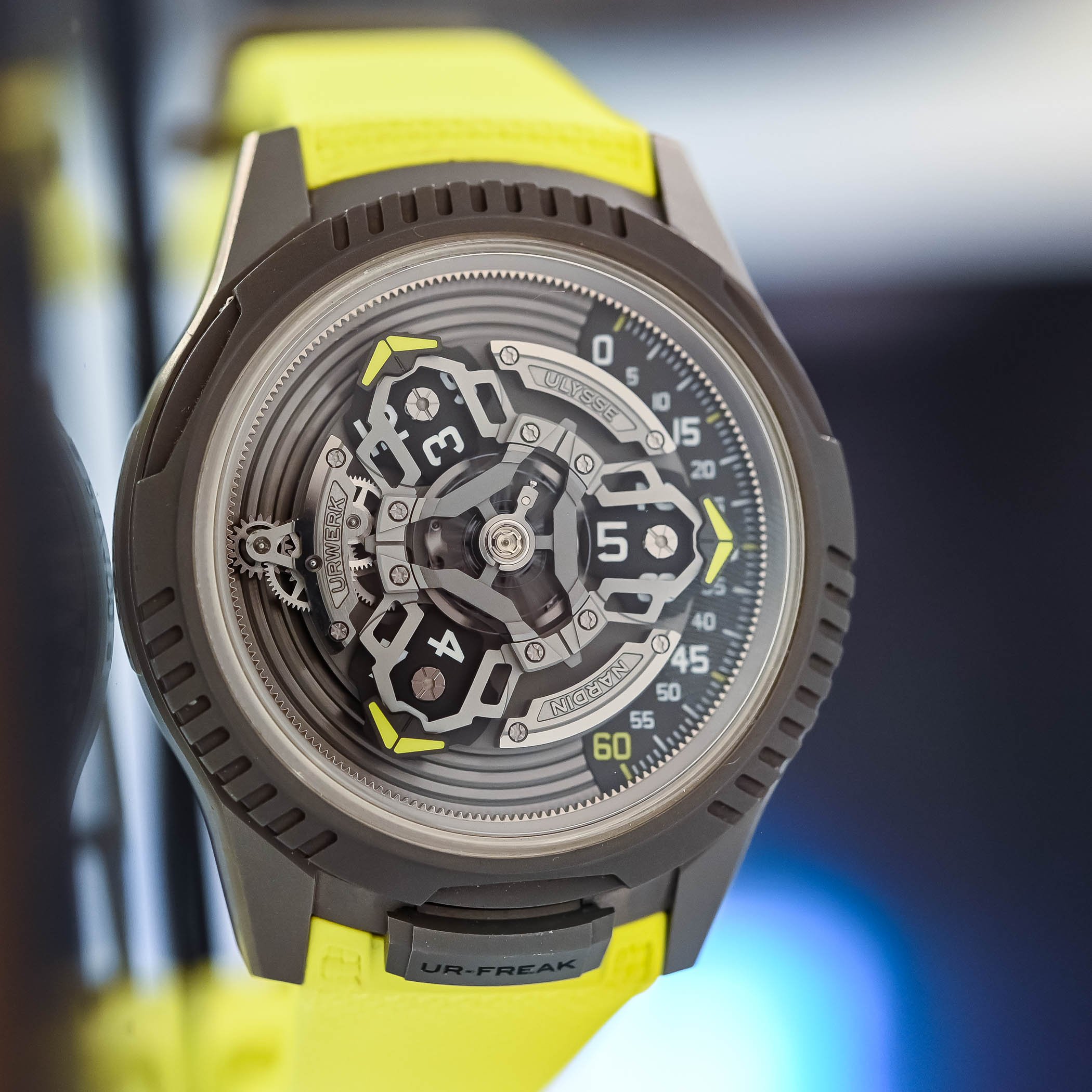
The rotating carousel at the center of UN-241 is a direct evolution of the Freak mechanism and performs a full revolution every three hours. But unlike previous Freak models, which relied on a fixed bridge to support the gear train and escapement, the UR-FREAK integrates Urwerk's three-arm traveling hour satellite system directly into the rotating platform. Each arm rotates to indicate the current hour and instantaneously advances across a series of Geneva crosses and star wheels that choreograph a seamless sequence of movements.
On the same mobile platform is mounted the control organ: an oversized silicon oscillator (what else…), 25% larger than standard for improved inertia and stability. Its continuous rotation, similar to a tourbillon or carousel, compensates for positional errors and thus improves the precision of timekeeping. The oscillator beats at 21,600 vibrations per hour and is regulated by a balance wheel with variable inertia and four gold weights. Both the escape wheel and anchor are made from DIAMonSil, Ulysse Nardin's proprietary diamond-coated silicon composite, which provides ultra-low friction and exceptional wear resistance, eliminating the need for traditional lubrication.
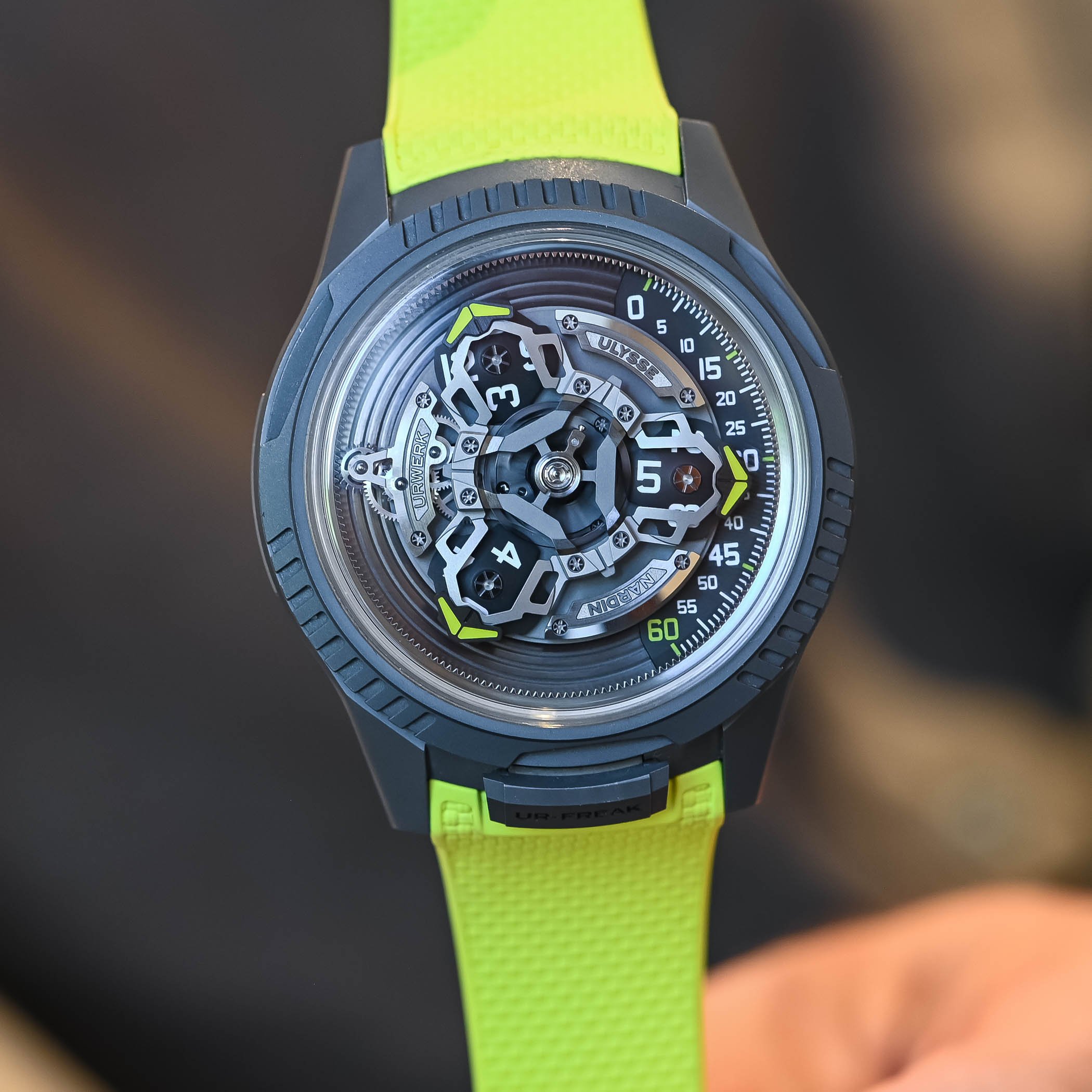
Power is supplied by a single barrel, which offers an impressive 90-hour power reserve despite the power requirements of the rotating assembly. Winding efficiency is achieved by Ulysse Nardin's Grinder system, a spring-loaded four-blade rotor that detects even the slightest movement of the wrist and converts it into torque. Compact, efficient and almost twice as effective as a conventional rotor, the grinder system ensures consistent energy delivery with minimal effort.
The UR-FREAK show unfolds in full length as the wandering hourly satellites dramatize the passage of time. Nevertheless, the innovation lies in the invisible precision of its materials. Ulysse Nardin brought the use of silicon to watchmaking with the original Freak in 2001, and this 2025 collaboration continues that legacy. Silicon's nonmagnetic properties, light weight, and self-lubrication make it ideal for high-frequency escapements. The addition of DIAMonSil (a diamond-coated silicon composite) enhances these properties, creating components that are virtually friction-free, corrosion-resistant and durable.
Together, silicon and DIAMonSil form the invisible foundation of the UR-FREAK's performance, ensuring that the watch's longevity matches its avant-garde mechanics. The technical materials guarantee precision and durability and UR-FREAK becomes a seamless synthesis of visible art and hidden science.
Thoughts
The UR-FREAK is a meeting of two autonomous creative minds. Felix Baumgartner and Martin Frei von Urwerk view watches as kinetic sculptures in which technology and emotion are inextricably linked. Ulysse Nardin sees the Freak as an ongoing laboratory in which new materials and movement concepts are tested. Both brands value the same thing: the freedom to invent without concessions, whether it's machining silicon components in-house or reimagining how hours pass through a watch face. The UR-FREAK is the product of this freedom: a true technical partnership and not a superficial co-branding exercise.

Mechanically, it sits right at the intersection of tradition and innovation, combining Urwerk's roving hourly satellites with the Freak's rotating carousel in a single, integrated caliber. Visually, it expresses the futuristic minimalism that each brand has refined over decades.
Availability and price
The UR-FREAK is a statement that the spirit of innovation that defined the independent revolution of the early 2000s is not only alive, but accelerating and on its way to becoming a collector's item. It is produced in a limited edition of 100 pieces and the price is 100,000 francs (excluding taxes).
Further information can be found at www.ulysse-nardin.com and urwerk.com.
https://monochrome-watches.com/ur-freak-ulysse-nardin-x-urwerk-collaboration-watch-price-video-review/