Timex has been on the rise in recent years, returning to mechanical watches after a decade-long hiatus. Of course, quartz watches still dominate the portfolio since the brand first stopped mechanical production in 1982. After the re-release of the hand-wound Marlin from the 1960s, a renewed focus on mechanical collections in the lower and mid-price segment began in 2017. The latest MK1 Automatic Watch is a faithful military-inspired field watch, a modern and affordable variant of the MIL-W-46374 military watch issued to US soldiers after World War II, with contemporary size and movement. And it offers a fit and finish that belies its affordable price. This would have been unthinkable a decade ago, but here we have another Timex that can now compete with counterparts from Seiko, Bulova and even Hamilton.
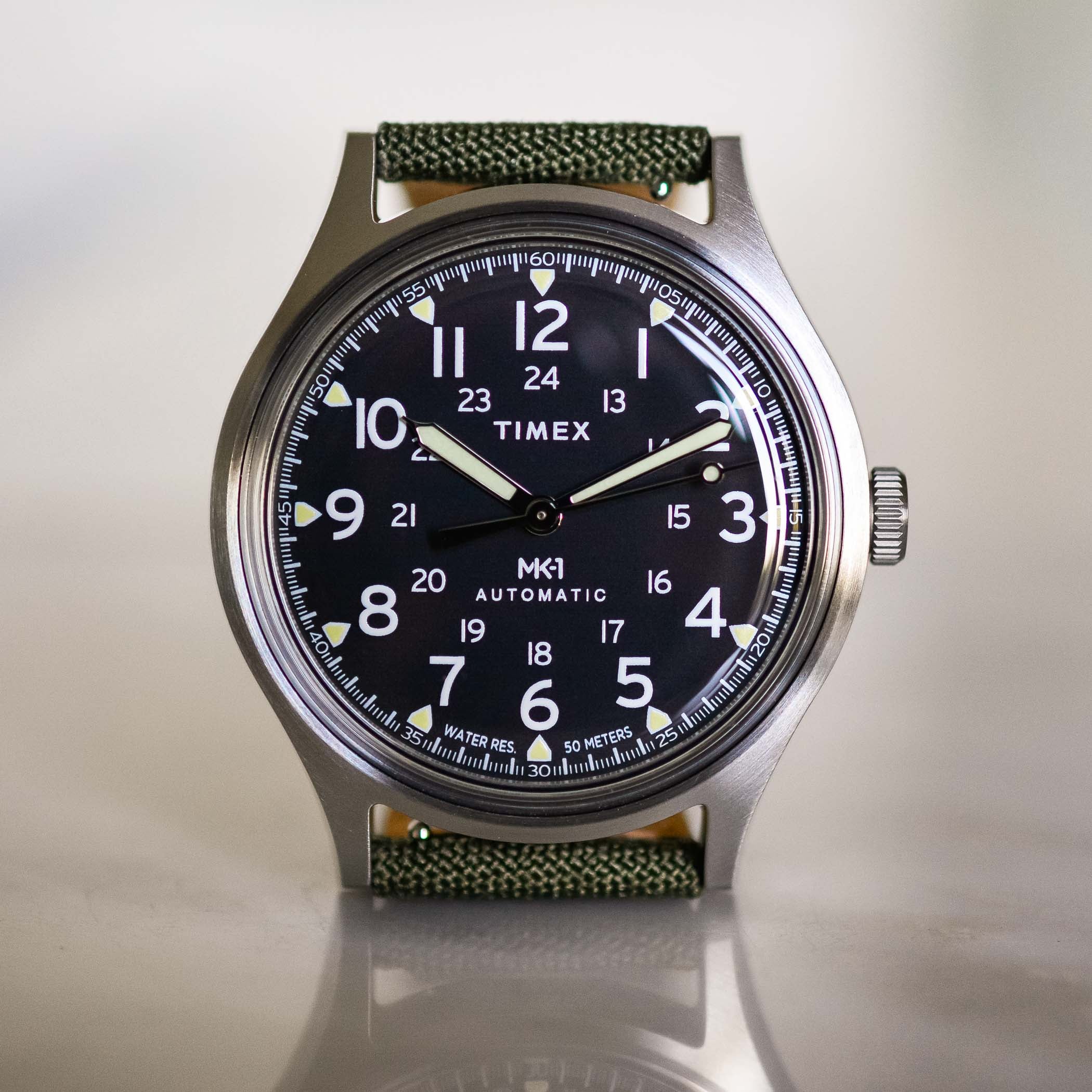
I vaguely remember a hand-wound 1970s Timex Mercury that I got used in the early 1980s, but my memory of Timex is otherwise quartz. From the legendary digital Ironman to the launch of Indiglo in 1992, Timex and Quartz are essentially synonymous. As noted in the recent ABCs of Time article, the return of mechanical watches to a quartz-focused brand like Timex highlights how consumer preferences have changed over the last decade – so much so that Timex and Casio are making mechanical watches! Timex Atelier and Giorgio Galli are affordable luxury collections with decorated Swiss movements, sapphire crystals, partially skeletonized stainless steel or titanium cases, tool-free adjustable bracelets (no separate pins or screws), and Super-LumiNova, priced between $1,000 and $2,000. The latest MK1 automatic follows an earlier 36mm MK1 that used the manual Marlins' hand-wound Seagull movement, but the new model features a better Japanese automatic and more refined workmanship. Both models are evolutions of the 1980s Timex Camper (as worn by MacGyver, in case you're old enough to remember).
Case and design
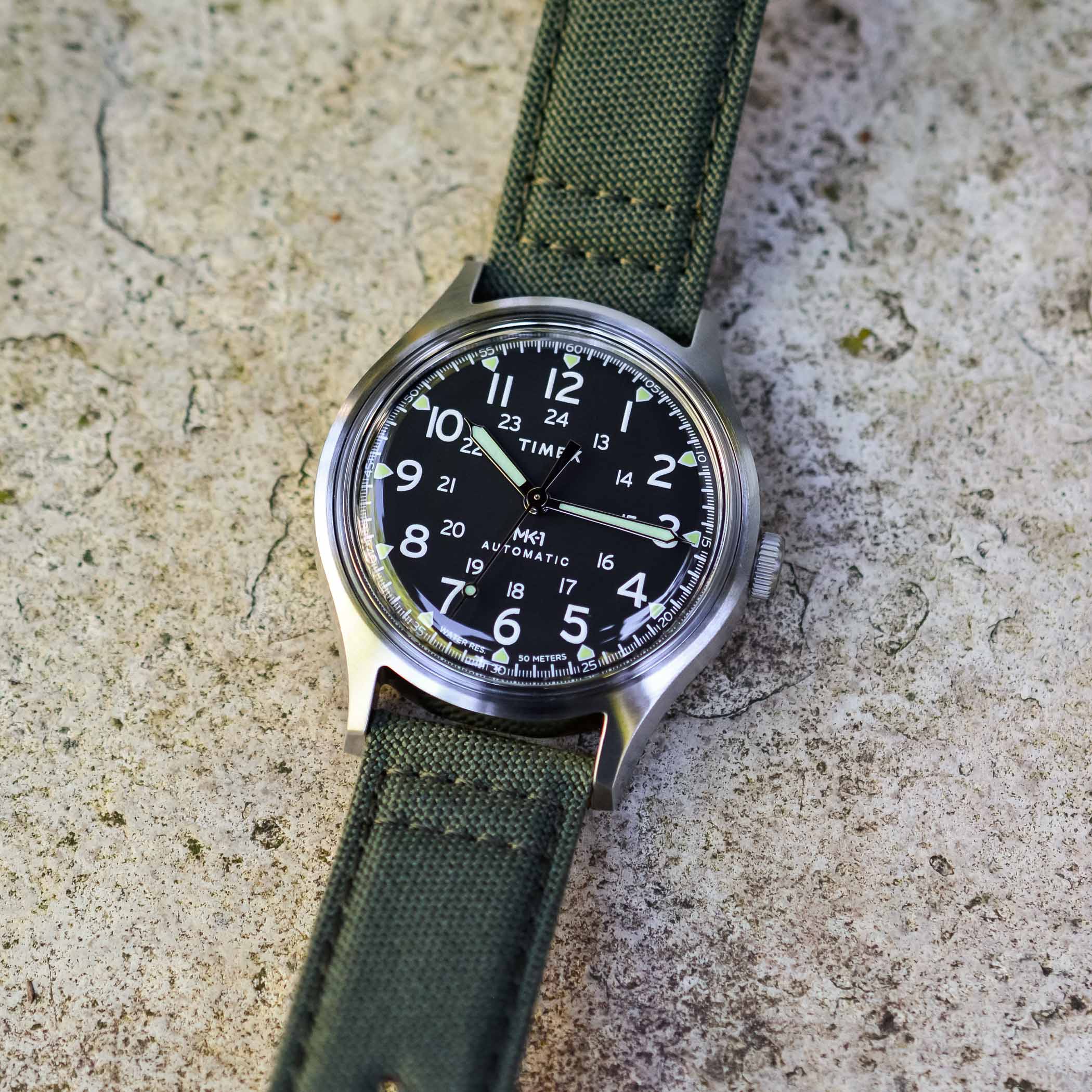
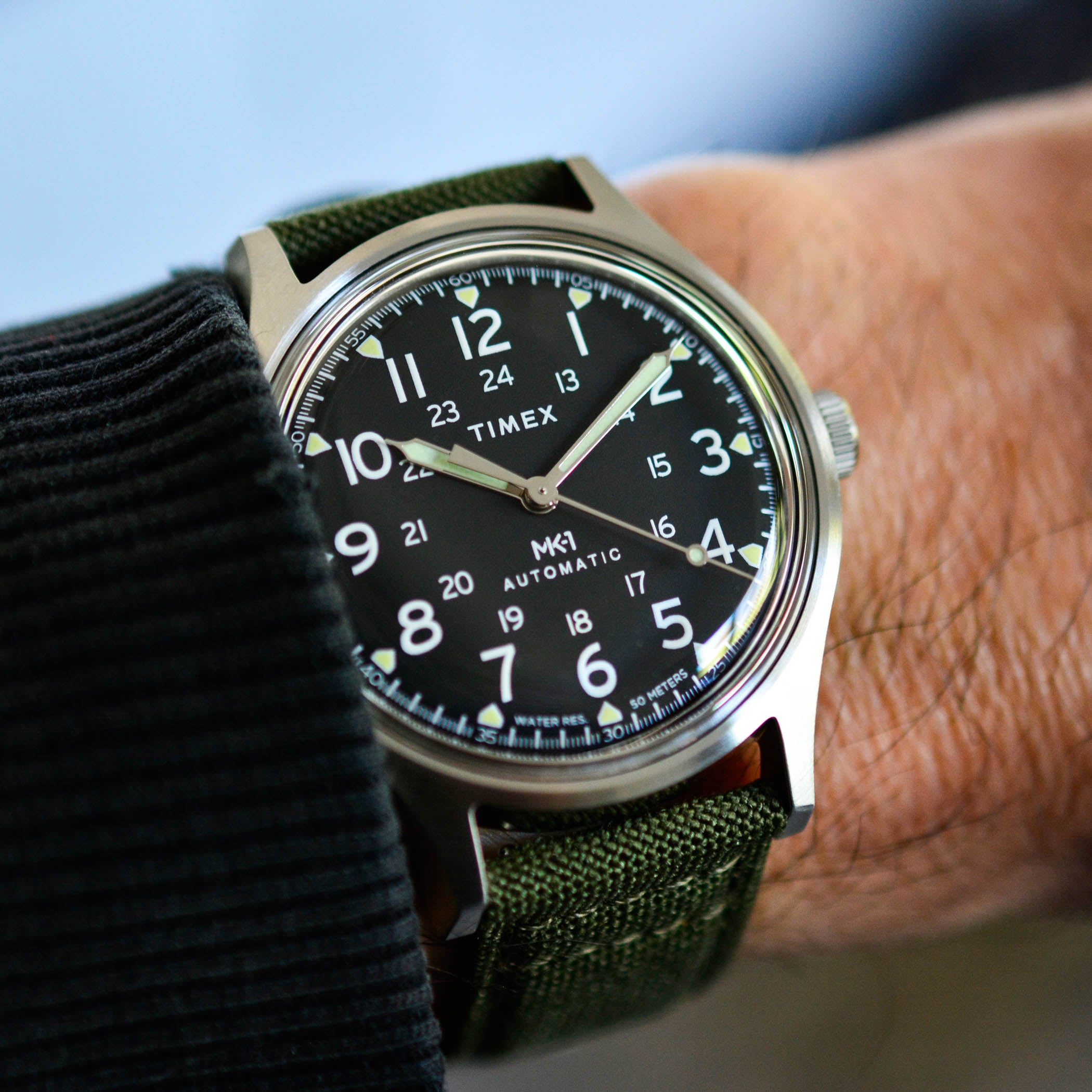
The Timex MK1 Automatic's stainless steel case has a diameter of 40mm and a height of 13.6mm (47mm lug to lug), which is an ideal size for most wrists today. Note that the height was measured with a caliper – 13.6mm with glass and 9.3mm without – so I'm not sure why 12mm is listed in the official specs. The tall, boxy acrylic crystal has a vintage warmth and nice distortions in the angles, and while I usually prefer sapphire crystal, in this case it works well for a retro touch that won't break. With such a high dome it's a bit reflective, but for the optics it's a worthwhile compromise. It definitely makes the watch quite bulky, but also has an undeniable charm.
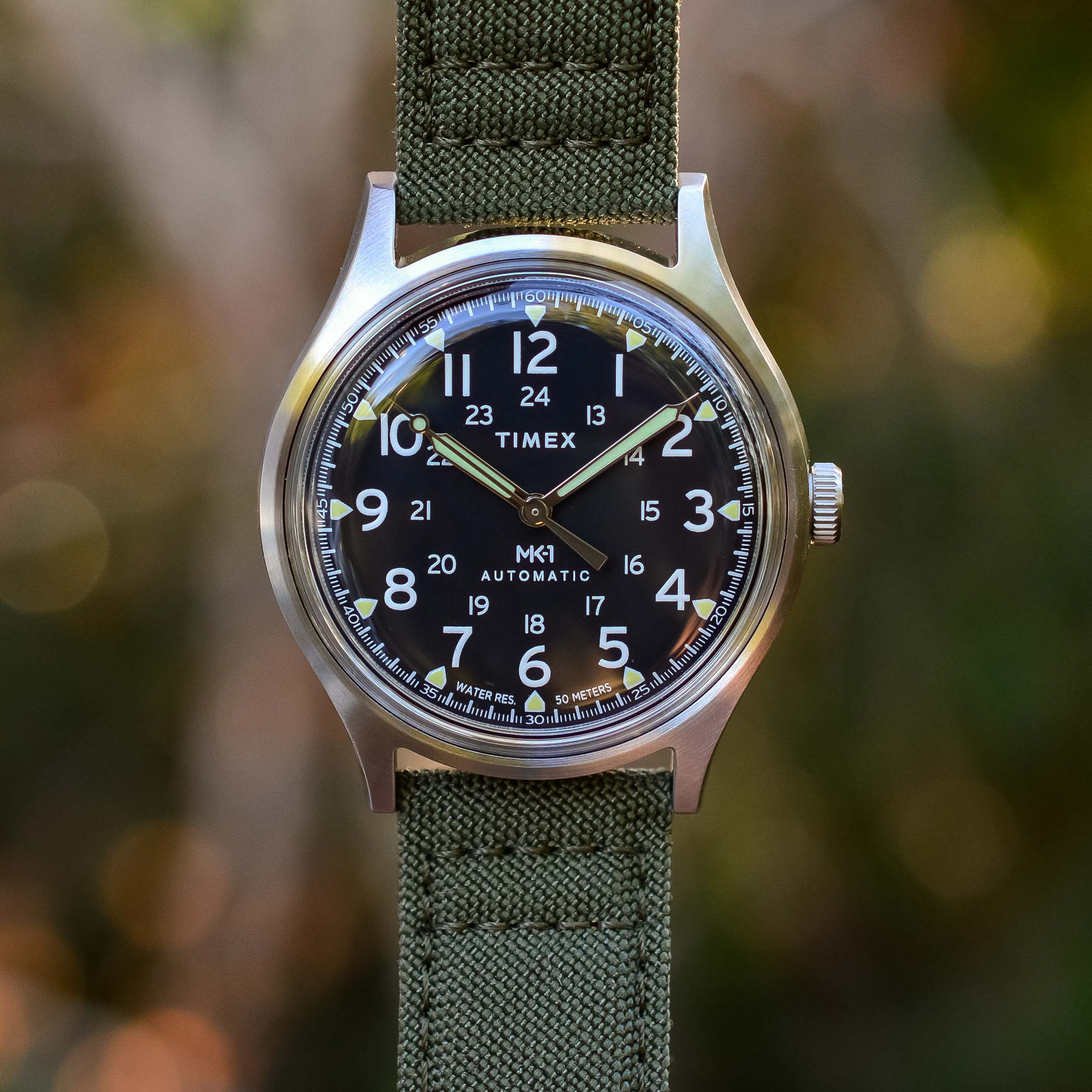
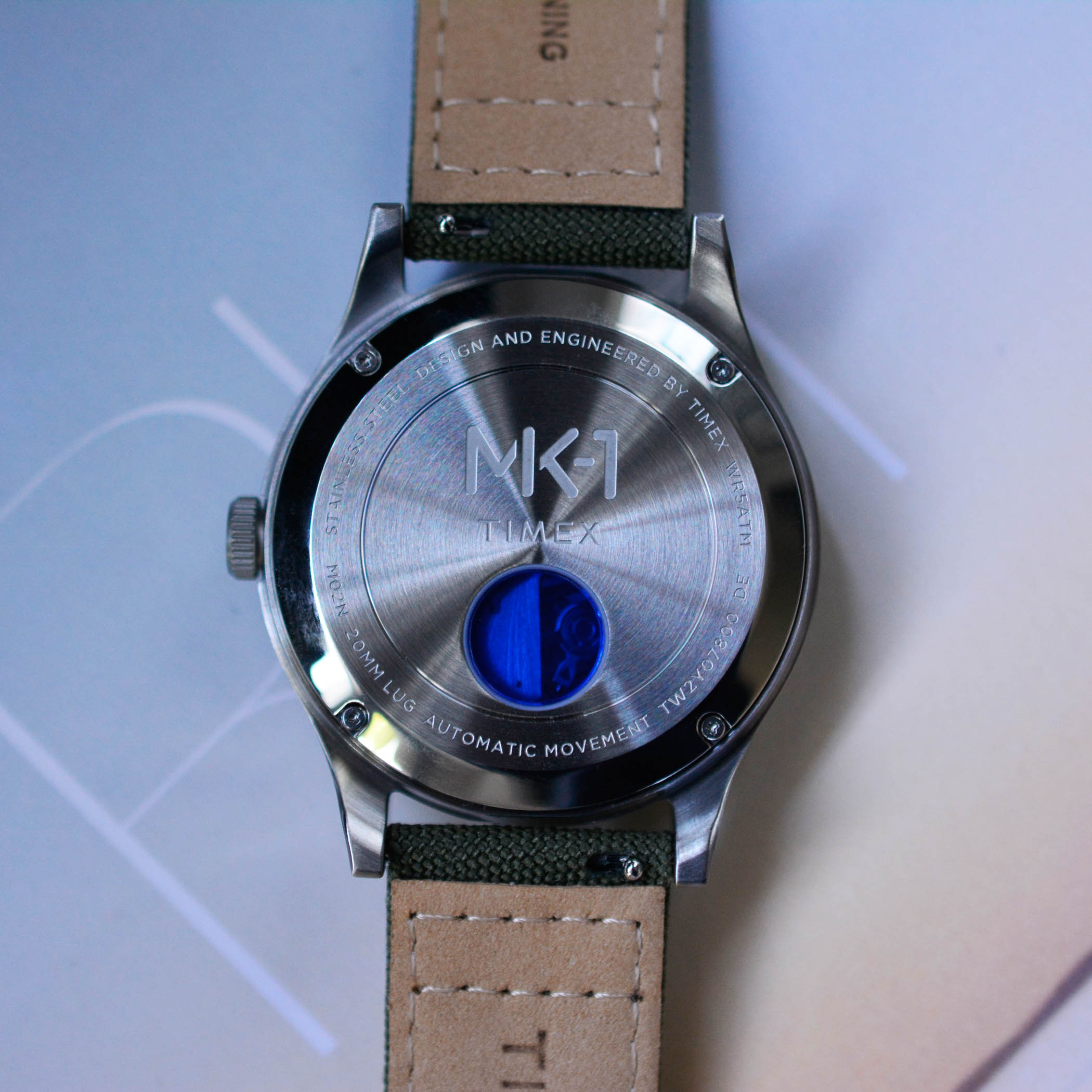
The caseback is mostly solid, but there is a nicely tinted blue porthole at the bottom that allows a view of the movement (a rather surprising choice considering the vintage style of the watch…). The brushed finish is beautiful and beats the older 36mm hand-wound model, and it looks and feels just as good as a Hamilton Khaki. There is a push/pull crown and the water resistance is 50 meters – a screw down crown and 100 meters would have been great, but 50 meters is perfectly fine for a field watch. The case is fitted with a 20mm green Cordura fabric strap with leather backing and quick release levers. It's comfortable right out of the box and a tan counterpart is also available.
Classic military dial
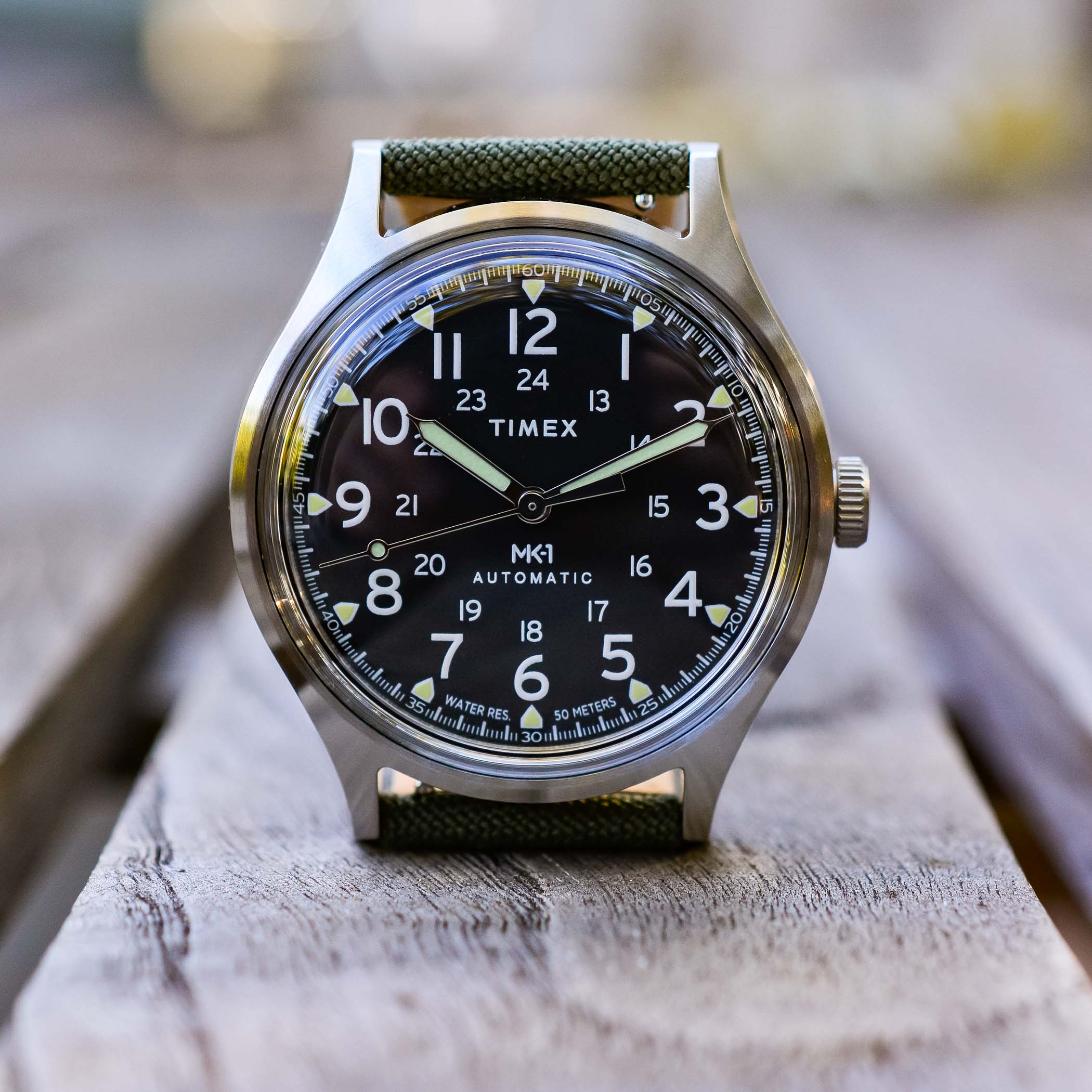
The black dial contrasts well with the oversized white Arabic numerals, which house a smaller 24-hour scale inside. A detailed white minute/seconds display spans the perimeter with Arabic numerals every five minutes and triangular markers below. The syringe-style hour and minute hands feature Super-LumiNova, as do the triangular markers and hole for the lollipop seconds hand. It's all very readable and has a classic military aesthetic, like it came straight from the 1960s. One minor criticism would be the water resistance rating, which is printed at the bottom just above the rail. It is split into two lines on either side of the 6 o'clock mark, which are then centered between the marks. It looks a little bumpy and out of place, and I could have done without it (although admittedly it is small). Everything else is very well implemented.
Japanese engine
The Timex MK1 is powered by a Miyota 8215 automatic movement with 21 jewels, a beat frequency of 21,600 vibrations per hour (3 Hz) and a power reserve of 42 hours. It features Citizen's Parashock shock resistance, stop seconds and can be hand-wound (older versions of this movement lacked the latter two). Functions include central hours, minutes, seconds and date (although date is not used here). Accuracy is quoted as -20/+40 seconds per day, but in practice it is generally well within these parameters. The second hand of this particular movement sometimes tends to “stutter” due to the indirect drive system for the central seconds. It might sometimes seem like it hesitates for a second and then catches up, which is completely normal and fortunately rare. A step above a Seagull equivalent, the Miyota 8215 really rounds out this versatile field watch, especially for the price.
Final thoughts
I'm a big fan of military-inspired field watches, and Timex nailed it. The dial is exactly what you'd expect from a piece like this, and the cool thing about these field watches is the similarities between different brands – it's a common formula and little changes here and there differentiate them. After all, the specifications of a MIL-W-46374 watch were the same back then, regardless of the brand. A few close competitors for the Timex MK1 are the Bulova VW1 Hack, Seiko 5 SRPJ85 and Praesidus Field Watch, showing that well-equipped mechanical military/field watches can be had for less than a Hamilton Khaki Field Auto or Vaer A5 Field Auto (as examples). The Timex looks and feels almost as good as its more expensive counterparts, and the tall, boxy crystal really complements it. Acrylic is somewhat prone to scratches, but most can be easily polished out. If you don't fancy something made in Switzerland, the Timex gives you everything you need from a sturdy field watch to a nice everyday watch, for about half the price.
Availability and price
The Timex MK1 retails for just 279 euros or $299, which is quite a bargain for what you get – excellent fit and finish, tall box-style acrylic crystal, Miyota automatic under a partially visible caseback, and classic aesthetics. For more information and to order, please visit the Timex website.
https://monochrome-watches.com/timex-mk1-automatic-review-faithful-affordable-take-on-military-watch/